Handwriting-recognition smart pen
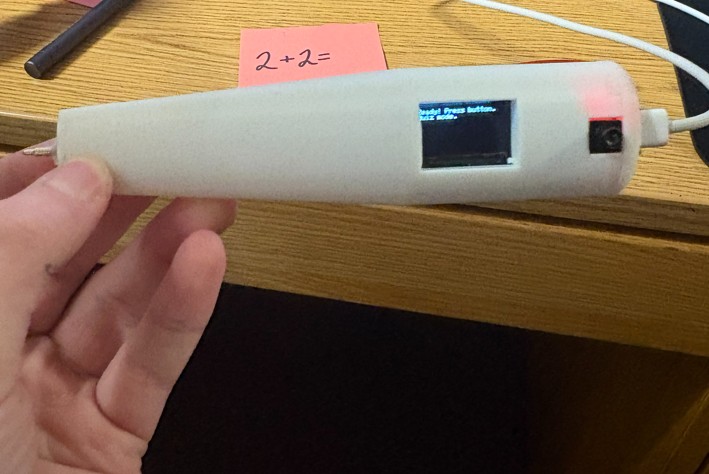
A pen that reads your handwriting on the device itself. The machine learning runs locally on the pen, with no phone and no cloud. I designed the electronics for it: 214 components across 11 hierarchical schematic sheets, drawn entirely by hand in KiCad. The design fits a normal-sized pen body and targets about 10 hours on a charge. The board layout is underway and boards come back around November.
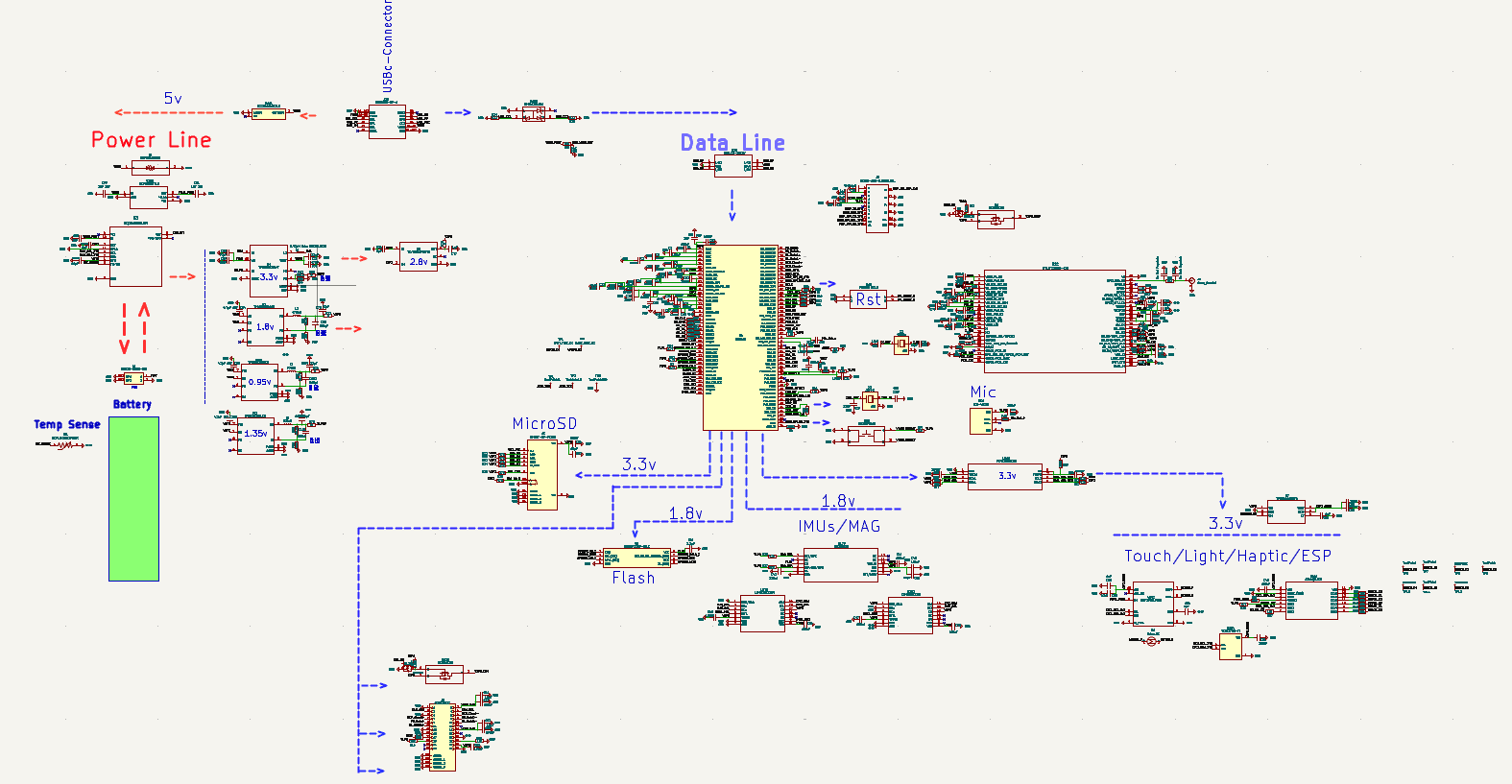
The core problem is measuring how a pen moves in three dimensions accurately enough to reconstruct letters. I put two inertial sensors at opposite ends of the pen, at the tip and the tail, because the further apart they sit the more clearly rotation shows up as a difference between them. A magnetometer fills in absolute orientation, and a small camera on a two-lane MIPI interface acts as a tiebreaker for characters the motion data isn’t confident about.
The part that took the longest was power. A pen has almost no room for a battery, so idle draw decides whether the thing is usable. I designed the full tree: USB-C charging and protection, a buck-boost converter to 3.3 volts, and dedicated 1.8 and 1.0 volt rails for a RISC-V processor with an on-die neural accelerator, plus load switches that cut power to the camera and sensor domains entirely when they’re not in use.
I wrote my own netlist checkers, which parse the schematic looking for nets that appear only once. A net with a single connection means something is wired to nothing, and it’s the kind of mistake that’s invisible in a schematic and expensive on a fabricated board.
- 2× LSM6DSO32 IMU, tip and tail
- IIS2MDC magnetometer, 9-DOF orientation
- OV5640 camera, 2-lane MIPI CSI-2
- SG2002 RISC-V SoC, on-die NPU, inference on device
- USB-C charge + protection, buck-boost to 3.3 V
- Dedicated 1.8 V and 1.0 V rails, load-switched camera and sensor domains